
Published by Nexcey Editorial Team · Researched & Fact-Checked · Editorial Standards.
Write the guide for the person making the next asset. That person may never meet the designer who created the identity. They need to know which file to use, how to place text and when to ask for help. A practical style guide answers those questions directly, with examples that remove guesswork.
Define scope and users
List who will use the guide—employees, agencies, printers, developers, partners—and which channels they manage. A startup’s guide may be ten useful pages; a global organization may need a governed design system.
Open with brand foundations
Summarize purpose, audience, positioning, promise, and personality. Visual rules make more sense when users understand what the brand is trying to communicate. Select high-contrast palettes and readable typography scales using our tutorial on how to choose brand colors and fonts.
Document the logo system
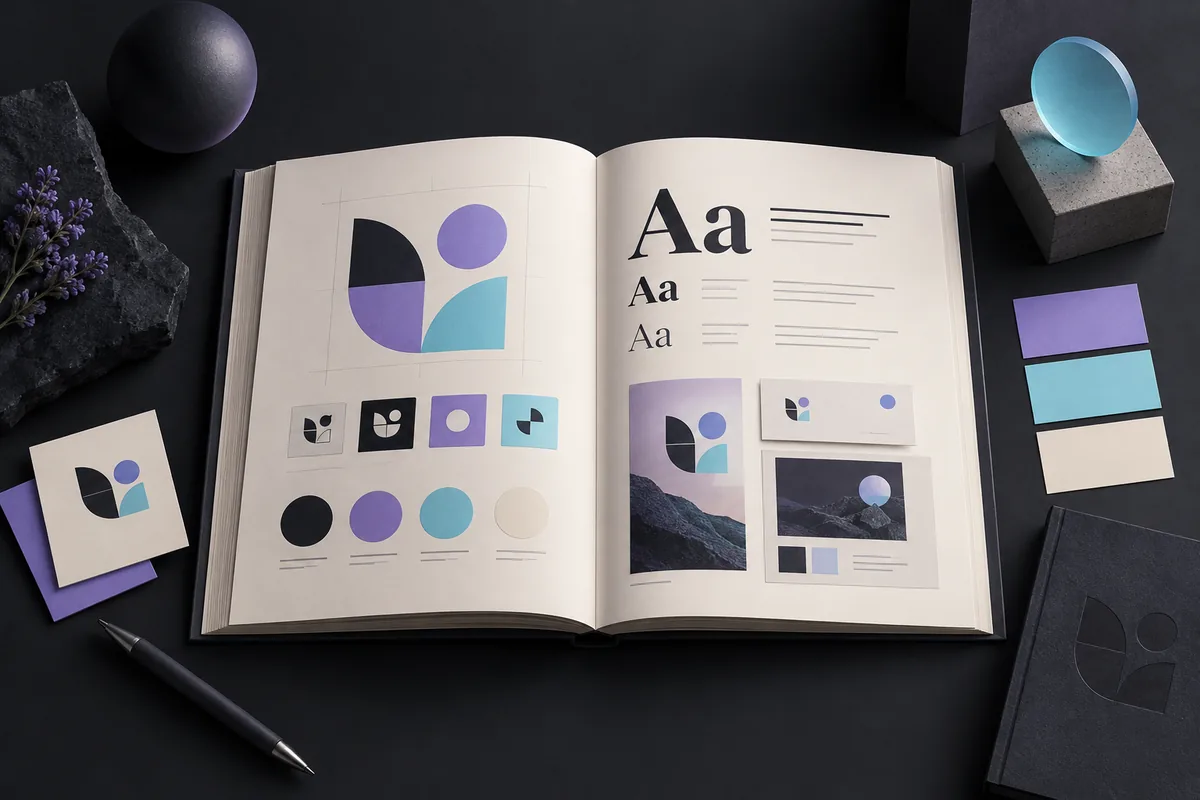
Show primary, secondary, compact, monochrome, and icon versions. Specify clear space, minimum size, acceptable backgrounds, file selection, and examples of distortion or alteration to avoid.
Specify color roles
Provide values for relevant formats and assign functional roles such as background, text, accent, success, warning, and error. Include accessible combinations instead of presenting swatches alone.
Define typography
Name primary and fallback typefaces, weights, heading levels, body styles, link treatment, line spacing, and usage across web and documents. Confirm licensing and language support.
Set imagery and illustration direction
Explain subject matter, composition, lighting, color treatment, cropping, authenticity, and what to avoid. Include examples relevant to the real business. Ensure your style rules support a cohesive company voice by exploring our guide to brand identity for small businesses.
Add layout and component rules
Document spacing, grids, corner treatments, buttons, forms, cards, icons, charts, and common patterns. For digital products, connect guidelines to reusable components.
Document voice and tone
Describe the default voice, vocabulary, grammar preferences, and tone shifts by situation. Include before-and-after writing examples for marketing, support, errors, and calls to action.
Provide templates and assets
Link to approved logos, fonts, presentation templates, social formats, documents, email signatures, and website components. Make the guide the trusted doorway to current files.
Assign governance
Name the owner, approval process, version, review date, and method for proposing changes. Archive outdated assets so they cannot compete with current files.
Practical checklist
- Guide users and scope named
- Brand foundations summarized
- Logo variants and misuse shown
- Color values and accessible pairs listed
- Typography and fallbacks documented
- Imagery direction illustrated
- Voice includes real examples
- Templates linked
- Owner, version, and review date visible
Frequently asked questions
What format should a style guide use?
Use a format people can find and update. A web page or shared document works well; provide exportable assets separately.
How long should it be?
Long enough to cover recurring decisions. A short guide with practical examples is better than an exhaustive document no one follows.
Who should own brand guidelines?
Assign one accountable owner who gathers input and manages approved changes, even when several teams contribute.
How often should the guide be updated?
Review it when channels, audiences, products, accessibility requirements, or recurring exceptions change.
Take the next step
Create practical brand guidelines with Nexcey.
Sources & further reading
Make exceptions easier to manage
Every rule eventually meets an awkward use case: a narrow sponsor logo slot, a printer with limited colour options or a language requiring different characters. Specify a sensible fallback and an owner for exceptions. Otherwise, people either improvise silently or stop using the guide.
Keep a version date and one current asset location. If you change a logo file, explain which old version it replaces and where the new one is required. Avoid keeping several folders called “final.” The guide’s value comes from making correct choices easy to find, not from the number of pages it contains.

A style-guide page people can actually use
A rule should answer a recurring production question. Instead of saying “keep it premium,” specify which file to use, what should remain readable and who can approve an exception. The example below is a practical starting structure.
| Section | Minimum useful instruction |
|---|---|
| Logo | Correct files, clear space and backgrounds |
| Colour | Role, value and tested text/background pairs |
| Type | Family, fallbacks, sizes and weights |
| Voice | A good sentence beside a sentence to avoid |
| Assets | A single current folder and named owner |
Brand guide worksheet
Use this editable worksheet to apply the guide to your own project. It is a plain-text file; no signup is required.
Download brand guide worksheetContinue with a related guide
- Logo vs Brand Identity: What Is the Difference?
- How to Plan a Business Website: The Complete Guide from Idea to Launch